Squash vs padel: what transfers and what doesn't
Both are played in a box with a racket. Almost nothing else is the same.
Plenty of people in N3 end up trying both, usually because squash here is members-only and padel is not. If you are moving between them, these are the differences that show up in the first hour on court.
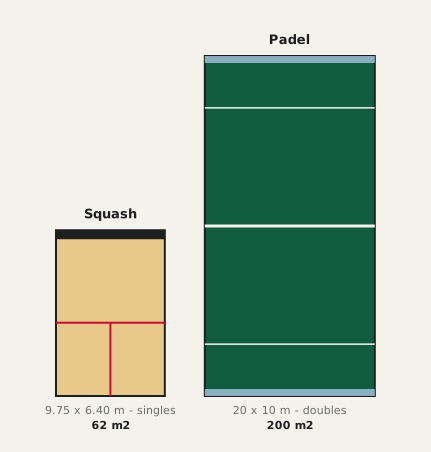
Side by side
| Squash | Padel | |
|---|---|---|
| Court | 9.75 × 6.40 m, sealed box | 20 × 10 m, net-divided, glass ends |
| Playing area | about 62 m² | about 200 m² |
| Format | Singles | Doubles |
| Racket | Strung, long-handled, 500-ish mm | Solid perforated bat, max 45.5 cm, wrist cord |
| Ball | Small, hollow rubber, needs warming | Pressurised, tennis-like |
| Walls | All four in play, every rally | Rebound off your own back and side glass |
| Scoring | Point-a-rally to 11 | Tennis: 15, 30, 40, games, sets |
| Serve | Overhead or side, into opposite quarter | Underarm, below waist, after a bounce |
| Intensity | Continuous, very high | Intermittent, longer rallies |
| Local access | Members-only at 5 of 6 venues | Pay and play almost everywhere |
The court
Squash is a singles game in a sealed box, 9.75m by 6.4m, with every wall in play and a front wall you must hit every rally. Padel is doubles on a 20m by 10m court, split by a net, with glass back and side walls that the ball may rebound off after it bounces on your side.
The consequence: in squash you and your opponent share the same space and constantly have to give way. In padel you have a partner and a half-court, and the walls are a resource rather than a boundary.
The ball and the racket
A squash ball is small, hollow and barely bounces until it is warm. A padel ball looks like a tennis ball with slightly less pressure and behaves like one. A squash racket is long, light and strung. A padel racket is a solid perforated bat, under 45.5cm, with a foam core and no strings at all, tethered to your wrist by a mandatory cord.
This is where squash players get caught out. Squash rewards a fast, wristy swing generated from a long lever. A padel racket has no strings to hold the ball and no length to whip — swing it like a squash racket and you will spray the ball long all evening. The correction is a shorter, flatter, more compact stroke, closer to a volley than a drive.
Scoring
Padel uses tennis scoring: 15, 30, 40, games, sets. Squash is point-a-rally to 11. If you have played tennis, padel scoring costs you nothing to learn. If you have only played squash, expect to lose track of the score for two weeks.
Physical load
Squash is the harder cardiovascular workout by a wide margin — continuous movement, sustained rallies, very high intensity for the duration. It is also harder on knees, ankles and the lower back because of the lunging and the changes of direction under load.
Padel is more intermittent. Rallies last longer, but the sprinting is shorter, and the doubles format halves your court coverage. For anyone returning from injury, or over about 45, this is usually the deciding factor.
Getting a game
In North London this is the real difference:
- Squash needs a club. Five of the six local venues are members-only, so you are committing to an annual fee and a fixed home court before you have hit a ball.
- Padel needs an app. You book a court, pay for the hour, split it four ways. But you need three other people — which is why the venue WhatsApp groups and mix-in sessions matter more here than the court quality does.
Which one, if you are starting now
Pick squash if you want maximum training effect per hour, you like playing alone against one opponent, and you are happy to join a club and play the same people regularly.
Pick padel if you want to play this week rather than next month, you would rather play socially in fours, or your joints have opinions about lunging.
In practice, plenty of people in Finchley do both: squash through the winter because it is indoors, padel through the summer because the local courts are outdoors and the evening slots run until dark.
Coming from squash specifically? The technique corrections are worth reading before your first session: padel for squash players.
Where to play: squash courts in North London · padel courts in North London
Common questions
Is padel easier than squash?
Easier to start, not easier to master. Underarm serving, tennis scoring and a doubles format mean most people rally on their first session, which almost nobody does in squash. The ceiling is just as high.
Can you play padel on a squash court?
No. A squash court is 9.75 by 6.4 metres with no net; a padel court is 20 by 10 metres and net-divided. No venue in North London converts between the two.
Does squash fitness transfer to padel?
The movement base does — split step, low centre of gravity, recovery to position. The swing does not. Squash generates racket head speed from a long lever and loose wrist, which sprays the ball long on a padel bat.
Which burns more calories?
Squash, by a clear margin. It is continuous singles movement at high intensity. Padel rallies last longer but the running is shorter and the court is shared with a partner.